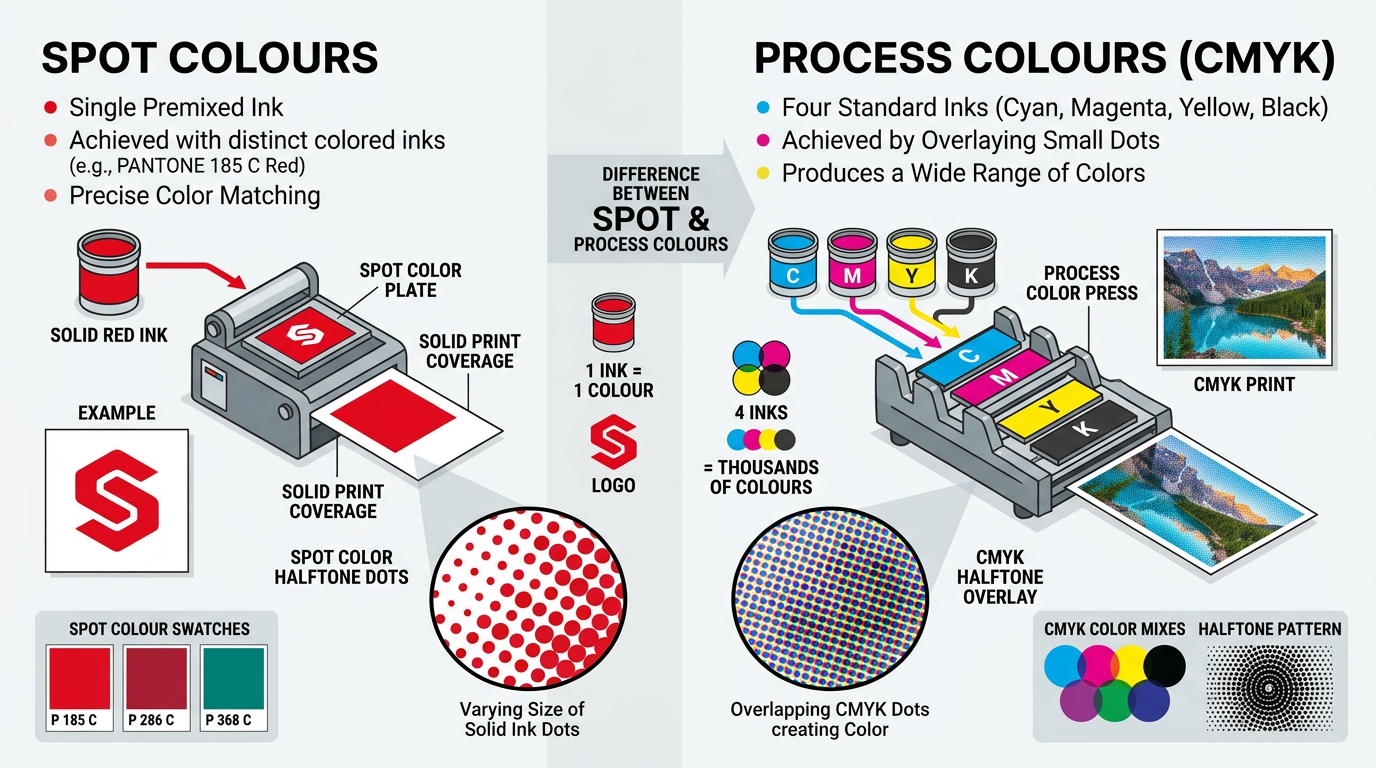
If you’ve ever prepared artwork for print, you’ve probably come across the terms spot colours and process colours. While they both relate to how colour is reproduced on paper, they work in fundamentally different ways—and choosing the right one can make a big difference to the final result.
What are process colours?
Process colours are the most common method used in full-colour printing. They’re based on four inks: Cyan, Magenta, Yellow, and Key (Black)—often referred to as CMYK. Instead of printing a single, pre-mixed colour, printers layer tiny dots of these four inks in varying proportions to create a wide spectrum of colours.
This method is what allows photographs and complex, multi-coloured designs to be reproduced so effectively. By adjusting the percentage of each ink, printers can simulate thousands—even millions—of different shades. For example, a deep purple might be achieved with a high percentage of magenta and cyan, while a warm orange leans heavily on magenta and yellow.
However, process colours do have limitations. Because they rely on blending just four inks, some colours—especially very vibrant or highly specific brand tones—can be difficult to reproduce exactly.
What are spot colours?
Spot colours, on the other hand, are pre-mixed inks created to match a specific colour exactly. Instead of building a colour from multiple inks, a spot colour is printed as its own individual layer using a dedicated ink.
This makes spot colours ideal for consistency. Brands often rely on them to ensure their logo looks the same across different print runs and materials. Spot colours can also achieve hues that are outside the CMYK range, such as bright fluorescents or metallic finishes like gold and silver.
When to use spot colours
Spot colours are particularly useful when precision or special effects are important. For example:
- Brand consistency: Ensuring a logo prints identically every time
- Limited colour jobs: Designs using one or two colours can be more cost-effective with spot inks
- Special finishes: Metallics, fluorescents, and varnishes
One common application is UV varnishing. In this case, a spot colour isn’t used to add colour, but to define where a clear, glossy coating should be applied. Designers will create a separate spot layer that tells the printer exactly which areas receive the UV varnish—often used to highlight logos, text, or images with a high-gloss finish that contrasts against a matte background.
Process vs spot: which is better?
It’s not really a question of one being better than the other—it depends on the project.
- Use process colours (CMYK) when your design includes photographs, gradients, or a wide range of colours.
- Use spot colours when you need exact colour matching, fewer inks, or special print effects like UV varnish or metallic finishes.
In some cases, both methods are used together. For example, a brochure might be printed in CMYK for images, with an additional spot colour added for a brand-specific logo or a UV varnish layer.
Final thoughts
Understanding the difference between spot and process colours helps you make smarter design and production decisions. Process printing offers incredible flexibility and range, while spot colours provide precision and creative finishing options. Knowing when—and how—to use each can elevate your printed work from good to exceptional.